
"A trademark obligee sued a snack bar because he believes the signboard violated the exclusive rights of his trademark "Yuan Ji". And it also indeed contains "Yuan Ji" in the signboard of the snack bar, but why does the Court finally adjudge the snack bar not guilty in infringement?
The results come out with reasons so that we should try to avoid future problems from source. This is true in life, as well as in law fields. By Legal Department of Asia Smart
Existing Common Concepts
Generally speaking, we believe that the business logo once registered successfully becomes the registered trademark, then the trademark legally enjoys exclusive use in designated area. If others who use it without authority indicates trademark infringement.
Regarding this point, it is clear that paragraph 2 and 3 of Article 57 in Trademark Law of PRC (hereinafter referred to as Trademark Law):
Without the permission of trademark registrant, one uses the trademark that is similar to or is the same with its registered trademark that can easily leads to confusion and merchandise sales infringing upon the exclusive rights of the registered trademark on the same commodity, which belongs to the infringement.
Therefore, the above mentioned content is almost common sense. However, in real business, this rule does not apply in all circumstances.
In fact, the higher prominence of the registered trademark is, the greater legal protection of the trademark is. However, the lower prominence of the registered trademark is, even if the registration of trademark is authorized by Trademark Office, it may still be difficult to prohibit others from using similar trademarks in similar or related fields.
Why would we say that? Let us get to know the following typical case. Based on judicial cases, it may be more direct to help us understand the reason.
Introduction of the case
Let us introduce the plaintiff who advocates trademark infringement in the case.
On December 21, 2012, the plaintiff Jin who was approved by the Trademark Office of the State Administration for Industry and Commerce obtained the registration of trademark with No. 9872865.
The trademark is approved to use in service item of category 43, including catering banquet, restaurant, diner, fast food restaurant, accommodation (hostels, catering accommodation), teahouse and places where provides camping facilities.
The registered trademark shall be valid from December 21st, 2012 to December 20th, 2022.
The logo is as follows:

On March 12, 2014, the plaintiff Jin signed contract to use the trademark with Yuan Ji Company, which licensed Yuan Ji Company to use Yuan Ji trademark with licensed using period from February 28, 2014 to December 20, 2022 in form of general use.
Shop of Yuan Ji marinated meat in baked bun
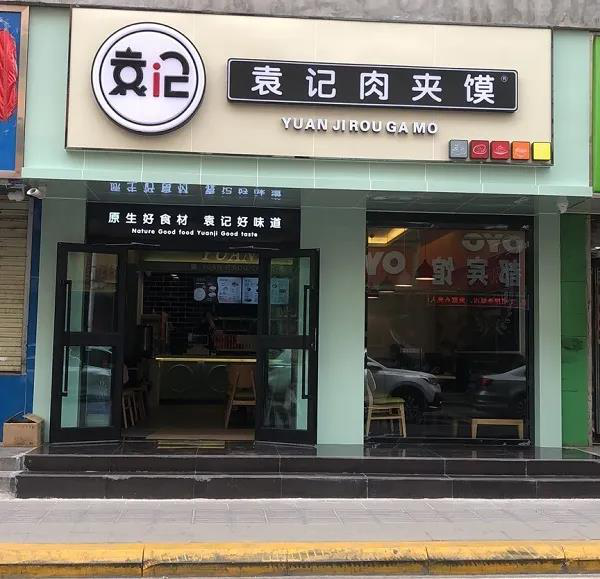
On September 13, 2014, the plaintiff Jin Jinkuang authorized Yuan Ji Company as plaintiff to participate in litigation of this case.
The plaintiff Yuan Ji Company is registered on November 12, 2012 by Shaanxi Provincial Bureau of Commerce and Industry, who can operate business in catering management (excluding operation), enterprise image, enterprise marketing planning, interior and exterior decoration in registered license. The company has hundreds of chains across the country.
Let us introduce the defendant.
Chengdu Yuan Yuan Industrial Co. Ltd is registered in Commerce and Industry Administration Bureau of Chengdu Wuhou District on September 7, 1999, who can operate business in catering, wholesale and retail of automobile accessories, hardware electricity, office supplies etc. in registered license.
The legal representative of the company, Yuan Gang opened his first hotpot restaurant in Chengdu fourth phase of Gulou north street in 1996 in individual catering household, named "Yuan’s Chuan Chuan Xiang".
Chengdu Yuan Yuan Industrial Co. Ltd. has had hundreds of stores and franchise stores in China over the years.
The trademark is as follows:
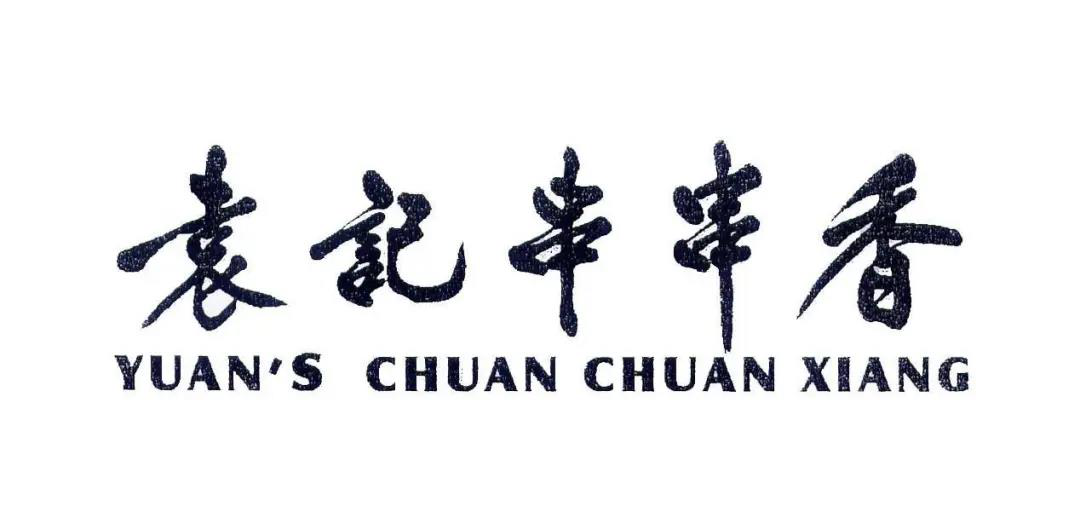
The application introduction of the trademark used by the defendant at that time is as follows.
On September 20, 2007, Chengdu Yuan Yuan Industrial Co. Ltd. submitted the application to the Trademark Office of State Administration for Industry and Commerce for trademark registration of "Yuan’s Chuan Chuan Xiang".
On December 10, 2009, the Office rejected the trademark registration application on "banquet, restaurant, diner, fast food restaurant, motel, cafe, cafeteria, bar, tea house" with the reason that the trademark is similar to "Yuan Ji" which is registered with No. 3258099 by Jin Jinkuang using in similar service category.
Later, the company applied for review. The Trademark Review Committee of State Administration for Industry and Commerce decided that the trademark should be approved for preliminary review.
During the announcement, the plaintiff challenged the Trademark Office. However, during this proceeding, the trademark hasn’t been registered.
Before releasing this article, the author verified it in the website of the Trademark Office. Currently, "Yuan’s Chuan Chuan Xiang" has already been registered successfully in catering business.
The defendant Zhang registered in Xi'an Industrial and Commercial Administration Bureau Yanta Branch on May 5, 2011 to establish Jianxiang snack restaurant in Yanta district, Xi'an for operating catering, and the operating site is No.139, Xiaozhai West Road, Yanta District, Xi'an.
On April 19, 2013, Chengdu Yuan Yuan Industrial Co. Ltd. signed trademark using authorization contract with the defendant Zhang, which authorized the defendant using the unregistered trademark of "Yuan’s Chuan Chuan Xiang" for Yuan Ji hot pot restaurant in Yanta district, Xi'an.

The defendant uses the trademark of "Yuan’s Chuan Chuan Xiang" in signboard, parking guidance map, posters, promotional materials and tableware wrappings.
The plaintiff believes that the behavior of the defendant who uses the trademark of "Yuan’s Chuan Chuan Xiang" violates his exclusive rights on the trademark, and sues to Xi’an Intermediate People’s Court.
The main reasons for the plaintiff to claim infringement are as follows.
(1) Since "Yuan Ji" brand has been established in 1980s, the plaintiff and his family business subjects successively inherited and continuously used "Yuan Ji". The trademark of "Yuan Ji marinated meat in baked bun with baked meat sauce" has been used for more than 30 years, and "Yuan Ji" brand in Shaanxi Province has extremely high popularity.
Considering that the alleged infringement occurred in Xi'an, when we take the popularity of "Yuan Ji" brand as an important factor affecting public confusion into consideration, the popularity in Shaanxi province should be mainly considered instead of the popularity beyond Shaanxi province.
(2) The distinctiveness in trademark law refers to the attribute of trademark which indicates that commodity or service source distinguishes it from other goods or services. The trademark "Chuan Chuan Xiang" and " marinated meat in baked bun with baked meat sauce" mentioned in this case belong to common commodity names of popular snacks, which are used in restaurants and snack bars, without any characteristics indicating goods or services.
(3) "Chuan Chuan Xiang" and "marinated meat in baked bun with baked meat sauce" respectively are the brand components of "Yuan’s Chuan Chuan Xiang" and "Yuan Ji marinated meat in baked bun with baked meat sauce", which do not have distinctiveness. Then, the trademark should be excluded in trademark comparison. However, "marinated meat in baked bun with baked meat sauce" has extremely high popularity in Shaanxi Province. Generally, consumers and the relevant public see "Yuan’s Chuan Chuan Xiang" in Xi'an will inevitably be misled to believe there is similar origin or relevance with "Yuan Ji marinated meat in baked bun with baked meat sauce".
In conclusion, the trademark sued by the plaintiff and the trademark of "Yuan Ji marinated meat in baked bun with baked meat sauce" belong to similar trademarks. Therefore, the defendant should bear the infringement liability.
The Court’s Opinions
However, after the first instance and second instance trial, why did the Court sentence the plaintiff to lose instead of infringement?
The first instance and second instance of Court believe that trademark of "Yuan Ji" and "Yuan’s Chuan Chuan Xiang" are used in catering services.
In catering industry, "surname + Ji" is a common way to name the trademark, and "Yuan" is also a common surname in Chinese nation.
Generally speaking, most of links caused by combination trademark of "surname + Ji" are related to the surname of service provider, but it does not necessarily indicate certain operators. Consumers often identify these products or services through other characteristics of these operators.
Since the trademark referred to in this case is registered on 2012, the case that the plaintiff uses "Yuan Ji" as trademark is not common, then the evidence submitted by the plaintiff can not prove that the Yuan Ji trademark has created close ties among the consumers through its use.
Instead, evidence provided by the plaintiff proves that "Yuan Ji Chuan Chuan Xiang" began to be used as a whole in 1996 and the use is far earlier than the plaintiff's trademark registration.
Although the main part of trademark "Yuan’s Chuan Chuan Xiang" used by the defendant contains the character of "Yuan’s", but "Yuan’s Chuan Chuan Xiang" used by the defendant has "Chuan" on its left side, "Yuan Yuan" on the right side, and "YUAN'SCHAUNCHUANXIANG" English annotation below.
Therefore, considering the differences between the plaintiff's "Yuan Ji" trademark and trademark used by the defendant, the usage and characteristics of "Yuan Ji" trademark, it cannot be considered that it will make confusion in the market and easily make public misunderstand or misbelieve that there are specific connections between the origin of commodity and the trademark products registered by the plaintiff, as the defendant uses the trademark "Yuan’s Chuan Chuan Xiang".
Accordingly, the original trial sentenced that the act of using "Yuan’s Chuan Chuan Xiang" trademark does not infringe the exclusive right of the plaintiff’s registered trademark. It is not improper to dismiss the plaintiff's claim.
Historical provisions concerning distinctiveness of surname trademarks
In 1994, Trademark Review Standards issued by China Trademark Office stipulated 15 items which are lack of distinctiveness that could not be registered as trademarks.
Subparagraph 5 stipulates that trademarks consisting only of common surnames with common fonts and designating for daily necessities or daily services are lack of distinctiveness cannot be registered, such as "Li Ji" trademark for pies and "Wang Ji" trademark for restaurants.
However, it also stipulates that surname trademarks are shown in special font or designated for non-daily necessities and services.
The basic reason is that surname trademark should not be exclusive. Daily necessities and services are closely related to our lives, and the suppliers are also many. If one owns the exclusive of a surname trademark, apparently it is unfair for other same surname products or services providers.
But, non-daily service providers are limited, and registration of surnames as a product or service trademark is minimal. It is reasonable to permit the registration.
However, in order to further regulate and conduct trademark examination and trademark review, according to the Trademark Law amended in 2001 and the Trademark Law Implementing Regulations promulgated in 2002, based on Trademark Review Standards enacted by Trademark Office in 1994 and Trademark Review Standards (Trial) formulated by Trademark Review Committee in 2001, Trademark Review and Adjudication Standards that combined with years of trademark review and trial practice, and .referenced overseas review standards for trademarks were formulated by Trademark Review and Adjudication Board in December, 2005.
Article 5 of New Trademark Review Standards in part II "Review of Distinctive Characteristics of Trademarks" defines other trademark cases that are lack of distinctive characteristics, and cancels surname trademarks, indicating that surname trademarks are no longer marked by legal provisions with lack of distinctiveness. Accordingly, the revised Trademark Review Standards allow registration of surname trademarks.
However, in judicial practice, we can find that trademark infringement caused by surname registration may not obtain the Court’s support.
Asia Smart’s Suggestion
Writing this article aims to suggest entrepreneurs who create brands at the very beginning, it is better to choose logos with high distinctiveness as business products or service brands as far as possible. Therefore, after the wide spread in market, entrepreneurs can actually obtain the legal protection for exclusive rights of the brand.
上一篇:没有了 下一篇:When sellers restock goods, what problems should be paid attention to avoid liability for trademark infringement?2020-09-21
2020-09-21
2020-09-21
2020-09-21
2020-09-21